
Personal news

Dear friends

Some of you may not already know that I’ve been undergoing a series of tests and scans over the last couple of months. The upshot is that I have (peritoneal) cancer and will be going through some treatment in the weeks and months to come, hopefully with a reasonably good outcome after all that! If this comes as a shock – you can imagine I’m also not a little stunned to find myself in this position, but at least we’ve finally got to the point where treatment should begin soon. And I’m grateful to live so close to an amazing hospital, St James’s (Leeds), with incredible staff and cutting-edge research links.

One of my ways of coping with this is to set myself a bunch of challenges, to keep myself sane and occupy my mind when I can’t do much physically. Though I’ll try to keep relatively fit, I won’t be running any marathons. Rather, I am going to do a load of things that I’ve long wanted to do – and now have the excuse to do instead of things I ought to do. What I’d really like, as your solidarity with me, is for you to think of something you’d like to do for yourself that you haven’t found time for in the hurly burly of life. Here’s my list – you can do something similar or something different:

  1. Learn by heart (and accurately) a set of poems (a dozen or so) that I love and already know snippets of. This will be great for moments when I’m left with only my thoughts.
  2. Learn all twelve major and minor blues scales on the trumpet. Accurately. I can work on this in my head (and with my fingers) without the instrument and then test myself when I pick it up. I can add further challenges once this is achieved, one of which is to really learn some charts thoroughly (melody, chord progression, improvisation approaches).
  3. Learn some simple classical piano pieces that I can sit and play for my own pleasure when I’m too tired to pick up the trumpet.
  4. Write a sonnet series (informed by some of the poems I’ll be learning as well as others by contemporary poets).
  5. Plot out the ‘cosy’ murder mystery book that I’ve been thinking about for a while. This might need a large pin board, but I’ll do some of it in my head!

These challenges are all aimed at occupying my mind so that I don’t drive myself mad with speculation and anxiety about my treatment. Obviously, I might not achieve them all completely, and I will need to rest as well as doing normal things like seeing family and friends. I look forward to coffee/tea/lunch/walks etc. with many of you in-between the treatment stuff.

Meantime, if you want to let me know what challenges you are setting yourself (just one will do!), please email me (lesjef56@gmail.com) or post on social media if you want to share! Or just do them and don’t tell anyone. That’s fine too.

And just to show you I’m not above cynically monetising my condition, though there really is no pressure at all to contribute… if you want to, please donate to Maggie’s at St James’s hospital (Maggie’s) and/or  HEART (HEART) both of which are going to be sanctuaries for me in the weeks to come. Or just give something to a charity you support already. The challenges are the main thing!

Thanks for listening – I love you all

Lesley xxx
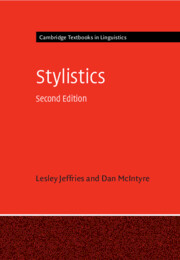
New edition!

I’m delighted that, after a few delays, Dan and I have finally seen the publication of the second edition of Stylistics (C.U.P. 2025). We are very pleased to have improved on the first edition in a number of ways, most notably in wider/deeper coverage of more recent developments in the field and in the addition of a ‘manifesto’ for stylistics, laying out its centrality to the discipline of linguistics, where it belongs. We’ll be happy to hear your thoughts on it when you have a chance to read it!

New horizons

I am delighted to announce that Lancaster University has appointed me as Honorary Professor in Linguistics and English Language! After the somewhat dismal end to a long career at another university, this feels good and I am looking forward to working on projects with colleagues at Lancaster. Watch this space.

Life stages!

I’m at that stage in life where my time is divided between work projects, retirement activities and grandparenting. The latter has taken up a lot of my time in the last few weeks, so this post is inevitably inspired by that preoccupation.

Last week, the night before her third birthday, I was putting my granddaughter to bed. We read one book and then she went to choose another. She rejected two of her favourites on the grounds that ‘They’re Italian’ as she knows I don’t speak much Italian and when I try it’s amusing to her. Her mother is Italian and she is bilingual, lucky lass. However, the third book she chose was also in Italian – it was a very simple one, with coloured dots and instructions like ‘shake the book to the right’ – resulting in the dots on the next page all being clustered at the right-hand side as if you’d shaken them there. We read the book together – me pronouncing the Italian and then trying out a translation and her watching proudly and prompting me when I couldn’t work out what a word meant.

Apart from the joy it brought us both, and the pride of this Nonna, the linguist in me wondered the following:

  • What meta-awareness of languages and related issues (like translation) do young children have, and to what extent is it a reflection of their own life experience? Up to then, I had only noticed her code-switching to speak to her Mum and the Italian Nonni, though she also does adorable things mid-sentence like ‘It’s a bit aperto’ when there was a hole in the skin of her mandarin.
  • What awareness of learning – and teaching – do they have? I felt that she was aware of teaching me and proud of my achievements!
  • Can young children assess difficulty of language? I was struck by her rejection of two narrative books and choice of a simpler one, also in Italian.

That’s it – I said they’d be short posts! And this time they are mainly questions – each of which could provide the impetus for a research project or PhD. You’re welcome.

Linguistics

This is going to be a very short blog to mark my retirement from The University of Huddersfield (on 6th October 2022) after 33 years of employment. It hasn’t been a happy end to my ‘career’ as the university decided to close down our courses and make my colleagues redundant in June, leaving me with no team to be attached to in my retirement and thus no academic ‘home’ with which to be associated as I continue my various research and outreach projects.

However, I don’t want to dwell on the negatives, so the failings of management in UK Higher Education which are wreaking such havoc on departments such as ours will be left for another day. I have been fortunate to have worked with many wonderful colleagues over the years and I want to pay tribute to the collegiality of academic linguists, at Huddersfield and beyond, who are almost without exception wonderful people and fantastic collaborators.

This strength of the linguistics community has been evident in the run-up to my retirement when I was not only accepted as a visiting researcher at Lancaster University but welcomed by fellow linguists with a warmth and enthusiasm which took my breath away and somewhat made up for the feelings of rejection which have been growing as I get close to leaving my post.

So, there will be more posts to come, mostly less personal and more concerned with linguistic observations. But for now, my love-affair with linguistics, which started at age 18 when I picked up David Crystal’s penguin book ‘Linguistics’ in our sixth form common room, continues.

Preoccupations in linguistics and other issues

This blog will contain occasional short posts, which may be political, topical, self-promoting (rarely) or simply something I thought about on my morning run. All of them will be about language. Until now… and I’m using the website for my personal challenges during cancer treatment! I will also comment on the language I encounter in that process.